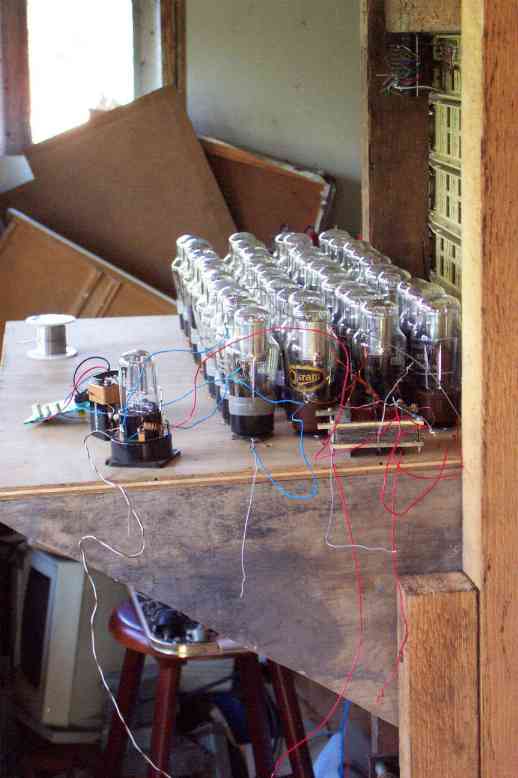
Having got the logic rack working with a simulated tape reader, the next
stage was to build a dual paper tape reader, a "bedstead".
Dr Arnold Lynch and Harry Fensom confirmed that the bedstead design produced
for Heath Robinson was used for Colossus so I revisited the CAD drawings
I made for the Colossus bedstead, built in 1994/5. Colossus had two reader
stations in one bedstead but they were never run at the same time. Paper tape
could be being loaded on one whilst Colossus was working on the other.
A switch on the Colossus control pane is labeled "near" and "far". For a
long time I didn't know what this did. It selected either the paper tape
station nearest to Colossus or the farthest one.
Heath Robinson required both tapes to be read simultaneously and for the paper
tapes to be kept in synchronism.
I reordered the steel angle iron from the same supplier (Charles Head's)
in Bletchley. They were rather surprised to receive a repeat order from 1994!
I calculated that I should just be able to assemble a full size bedstead in
one half of my garage and set to.
The steel was delivered to me on 26th June, the bedstead frame was completed
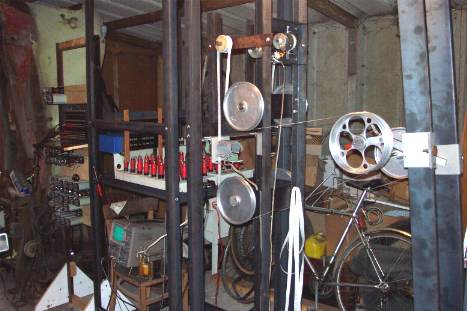
by mid July and the picture shows the situation on 20th August with one tape being
read. Then the second tape reader had to be completed. This was achieved
by 27th August and two tapes were read for the first time on 29th August.
I then returned to the decade counter circuits and the counter rack.
Harry Fensom had done a line drawing sketch of the counter rack so I
built one like that using wood so that it could be easily changed if
it didn't look right when completed. This was completed by 2nd September
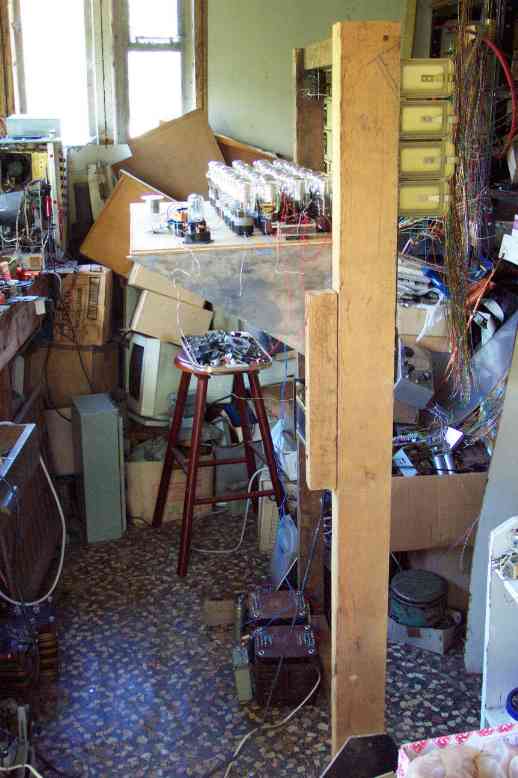
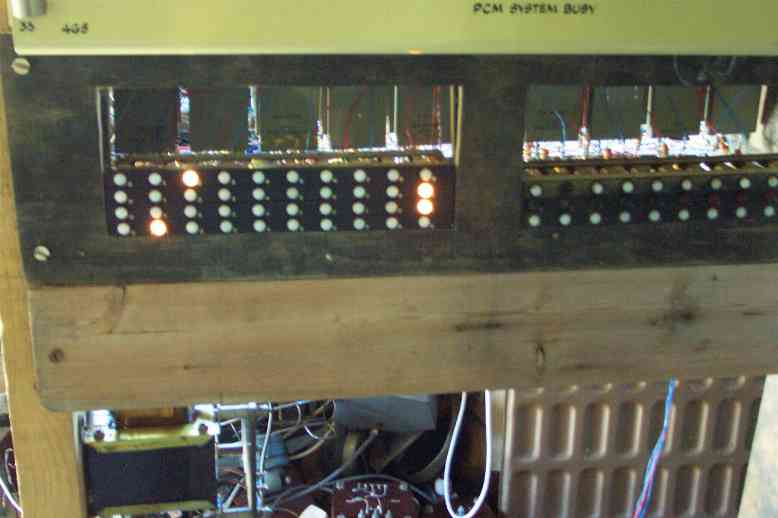
and the counters worked and showed their counts on the lamp panel.
I needed better power supplies for the logic rack and the counter rack
so raided some old (1980s) high current low voltage power packs, stripped out the mains
transformers and with a bit of judicious linking of wirings soon had
some realy good smooth power units. I could now tackle getting signals
all the way from the paper tapes to the counters.
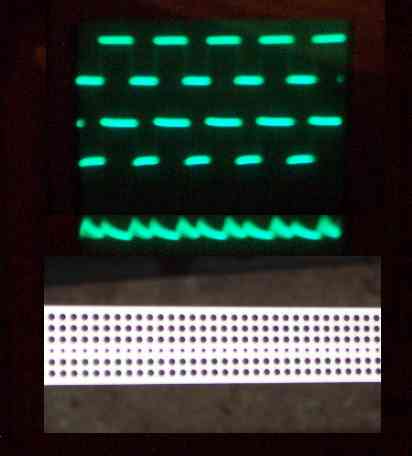
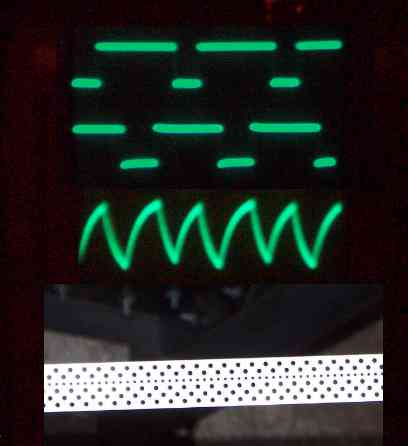
For the more technically minded readers here are the test runs that can now be done.
Two tapes have been made up, one with all holes on all characters (full) and one with
alternate R Y characters (RY). (x.x.x and .x.x.). The RY tape gives staggered
x and . down each channel and across each character. (This was a test tape used by
teleprinter engineers to test P/T readers.)
If the paper tape reader outputs are plugged into the logic rack and XOR'ed
together then the full tape should give zero on every comparison whilst the
RY tape should give one for current and previous characters on any one track
or on the same character on adjacent tracks.
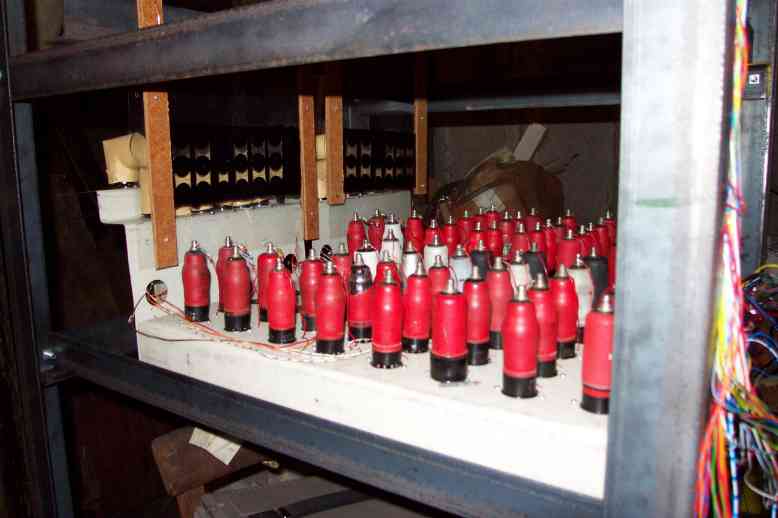
The pictures show the output signals and the input paper tapes.
The sprocket hole signals now have to sample the detector output to
give the pulses to be counted.
The big remaining problem is the synchronisation of the two tapes. This was
done originally by an idler shaft carying two sprocket drums which engaged
one with each tape. Harry Fensom reckons that ordinary Creed reader sprocket
drums were used and suggests I try these first. My own feeling is that
larger diameter drums would be better (more pegs engaged with the tape)
and I may try fabricating some myself.